

Product Description
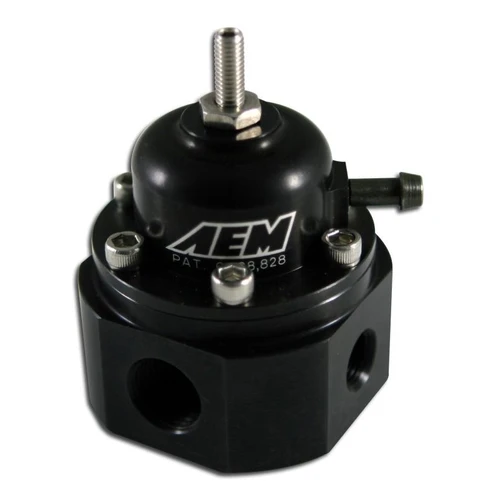
The AEM 25-302BK Universal Adjustable Fuel Pressure Regulator is a high-flow bypass-style regulator designed for performance EFI fuel systems that need more plumbing flexibility than a conventional application-specific rail-mounted regulator.
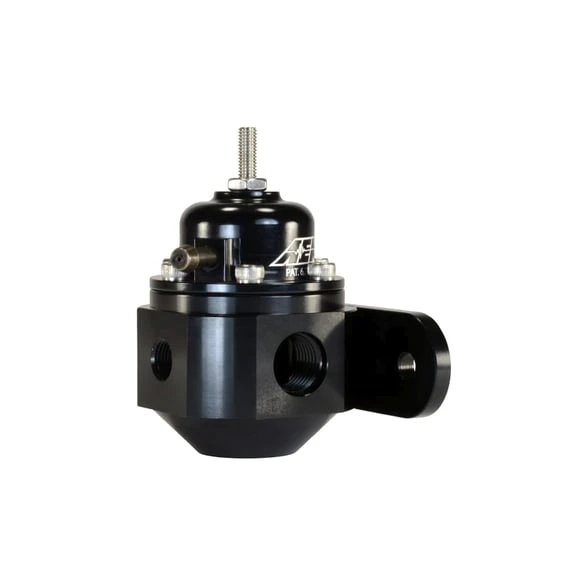
With two female -6AN fuel inlet ports, a female -6AN return outlet, an integrated 1/8 NPT gauge / sensor port, adjustable fuel pressure, and a 1:1 vacuum / boost reference, the 25-302BK works well in custom feed-and-return fuel systems where the regulator, fuel rail, feed, and return plumbing are being configured together.
Quick Specifications
- Manufacturer: AEM Performance Electronics
- AEM Part Number: 25-302BK
- Product Type: Universal adjustable bypass fuel pressure regulator
- Fuel Pressure Adjustment Range: 20-120 PSI
- Vacuum / Boost Reference: 1:1
- Fuel Inlets: Two female -6AN ports
- Fuel Return / Outlet: Female -6AN port
- Gauge / Sensor Port: 1/8 NPT
- Material: CNC-machined 6061-T6 billet aluminum
- Finish: Black
- AEM Fuel-Flow Rating: Supports racing applications up to 1,000 horsepower
- Mounting Bracket: Included
Universal Regulator for Custom Feed-and-Return Fuel Systems
The AEM 25-302BK differs from AEM's application-specific Honda and Acura rail-mounted regulators.
Regulators such as the AEM 25-300BK, 25-301BK, 25-303BK, and 25-304BK are designed to mount directly in the conventional factory-style regulator position on the appropriate Honda / Acura or compatible aftermarket fuel rail.
The 25-302BK is a universal regulator, allowing greater freedom in regulator placement and in how the fuel rail, feed plumbing, and return plumbing are arranged.
This makes it particularly useful when the fuel system is being upgraded beyond the original rail-mounted regulator architecture.
Configure the 25-302BK with JBtuned Fuel-System Fittings
JBtuned offers a range of O-ring-sealed adapter fittings for configuring the AEM 25-302BK around the fuel-system layout you need.
Depending on the application, the regulator can be configured for:
- -6AN fuel plumbing
- -8AN fuel plumbing
- Direct-mounted fuel rail / regulator arrangements
- Custom feed and return plumbing
- Other compatible fuel-system component connections
This allows the regulator to be integrated into the actual fuel system rather than forcing the entire system to be built around one fixed fitting arrangement.
Direct-Mount the Regulator to a Compatible Fuel Rail
For compact direct-mounted installations, the JBtuned Adjustable Stainless Steel ORB-to-ORB Fuel Rail / Regulator Adapter can connect the 25-302BK directly to a compatible aftermarket fuel rail.
The adjustable center locking section allows the regulator to be clocked into the desired position while eliminating the short hose assembly and additional adapter fittings that would otherwise be required between the rail and regulator.
This can create a cleaner, more compact regulator installation while reducing the number of separate fuel-system connections.
Need a Fuel Rail?
If the 25-302BK is being installed as part of a larger aftermarket fuel system, JBtuned carries a growing selection of performance fuel rails for different engines, vehicle applications, and fuel-system configurations.
Choose the fuel rail according to the engine and application first, then configure the regulator and plumbing around the ports and fuel-system layout being used.
Two -6AN Fuel Inlet Ports
The regulator body provides two female -6AN fuel inlet ports, giving builders flexibility in how fuel is routed into the regulator.
Depending on the fuel-system architecture, the dual-inlet arrangement can support different rail, feed, and regulator layouts without requiring the regulator to be used in only one orientation.
Any unused fuel port must be properly sealed with a compatible plug.
-6AN Fuel Return Connection
The regulator return outlet uses a female -6AN port and returns excess fuel from the regulator back toward the fuel tank.
JBtuned fittings can be used to configure the return side for the AN plumbing size and layout required by the complete fuel system.
The return system should be sized as part of the overall fuel-system design rather than treated as an afterthought when increasing pump and feed capacity.
1/8 NPT Gauge / Pressure Sensor Port
The integrated 1/8 NPT port provides a convenient location for a compatible mechanical fuel-pressure gauge or electronic fuel-pressure sensor.
A fuel-pressure gauge or sensor is especially useful when initially setting base fuel pressure and when monitoring or diagnosing a modified fuel system.
Adjustable Fuel Pressure
AEM specifies an adjustment range of 20-120 PSI for the 25-302BK.
Fuel pressure is adjusted using the screw and locking nut on top of the regulator. Final base pressure should be set according to the injector, ECU calibration, fuel pump, and complete fuel-system requirements of the vehicle.
Increasing fuel pressure is not a substitute for correctly sized injectors, fuel pumps, feed and return plumbing, or other fuel-system components.
1:1 Vacuum / Boost Reference
The 25-302BK uses a 1:1 vacuum / boost reference.
In a properly configured EFI system, regulator pressure changes in direct relationship to intake-manifold pressure so the intended pressure differential across the fuel injectors can be maintained as manifold pressure changes.
This allows the regulator to be used in both naturally aspirated and properly configured forced-induction fuel systems.
Interchangeable Discharge Orifice
AEM designed the 25-302BK with an interchangeable discharge-orifice system so the regulator's return-flow characteristics can be matched more appropriately to the fuel pump and overall fuel-system configuration.
This becomes increasingly important as fuel-pump capacity and return-flow requirements move farther away from the original vehicle configuration.
Part of a Complete Fuel System
A fuel pressure regulator should not be selected by horsepower rating alone.
The fuel pump, injectors, fuel rail, filter, feed plumbing, return plumbing, electrical supply, fuel type, regulator, and engine-management strategy must all work together as a complete fuel-delivery system.
AEM's up-to-1,000-horsepower specification describes the fuel-flow capability of the regulator in racing applications. It does not mean that installing the 25-302BK makes the complete fuel system capable of supporting 1,000 horsepower.
JBtuned complete fuel-system configurations are designed around the entire fuel path rather than treating the regulator as an isolated component.
25-302BK or a Rail-Mounted Regulator?
Choose one of AEM's application-specific Honda / Acura rail-mounted regulators when you want an adjustable regulator that mounts in the conventional factory-style regulator position and the rest of the fuel-system architecture supports that arrangement.
Choose the AEM 25-302BK when the regulator is becoming part of a larger custom feed-and-return system and additional freedom in fuel rail, regulator, feed, and return plumbing layout is useful.
Neither regulator style is automatically better for every application. The correct choice depends on the engine, fuel rail, pump capacity, injectors, feed and return plumbing, fuel type, and overall goals of the build.
Need a Different Fuel Pressure Regulator?
If the AEM 25-302BK is not the regulator style required for your application, browse JBtuned's complete selection of fuel pressure regulators for additional rail-mounted and universal regulator options.
What Is Included?
- AEM 25-302BK Universal Adjustable Fuel Pressure Regulator
- AEM regulator mounting bracket
- Mounting hardware
Fuel-line adapters, AN fittings, fuel-pressure gauge, pressure sensor, fuel rail, and JBtuned direct-mount adapter are sold separately.
Installation Notes
Fuel pressure must be safely relieved before installation or service.
Verify that all fittings, plugs, and adapters match the regulator and surrounding fuel-system components before assembly.
After installation, pressurize the fuel system and carefully inspect all regulator ports, fittings, plugs, fuel lines, and surrounding connections for leaks before starting or operating the engine.
Base fuel pressure and regulator configuration should be set according to the requirements of the injectors, ECU calibration, fuel pump, and complete fuel system.